

Quick answer: A 5th or 6th grader who still does not know the times tables is more common than most parents think, and it is fixable. Older kids do not need to relearn everything from zero, they need their specific gaps found and filled using methods that respect their age, not cartoon flashcards made for a 2nd grader.
It can feel embarrassing, for both a parent and a kid, to admit that a 5th or 6th grader is still shaky on times tables everyone assumes should have been locked in years ago. If you want a clearer sense of the typical grade by grade benchmarks, it helps to see how wide that normal range actually is. That feeling is understandable, and it is also not based on how common this actually is.
Gaps like this happen quietly. A rough school year, a move, a long absence, or facts that were crammed for a test and never truly stuck can all leave a hole that nobody notices until a child is staring at a fraction problem and cannot remember what 7 times 8 is.
This guide is a practical, respectful plan for closing that gap quickly, without baby stuff and without making an older child feel behind their age.
1. Why This Happens, and Where to Start Looking
A times tables gap in an older child almost never means a child cannot learn math. Far more often, a shaky year gets carried forward quietly, facts get memorized for a test and then fade once the test is over, or math simply moves on to new topics before fluency ever really locked in.

The first real step is not a full relearn, it is a quick self-check across all twelve tables to see exactly which facts are shaky. Most kids who feel behind are not missing everything, they are missing a specific, identifiable cluster.
If guessing instead of recalling has become a habit during that check, our guide to common multiplication mistakes can help you tell the difference between a true gap and a confidence issue that looks like one.
💡 Practical tip: Write out all 12 tables on one page and have your child circle only the facts they are unsure of. Seeing the real gap, usually smaller than expected, is often a relief in itself.
2. Use the Half-the-Facts Shortcut
Here is some genuinely good news for a kid who feels overwhelmed by a full times tables chart: it is not actually twelve times twelve separate facts to learn. Flipped facts are the same fact, 3 times 4 and 4 times 3 both equal 12, so the chart an older child actually needs to drill is roughly half the size it looks like.
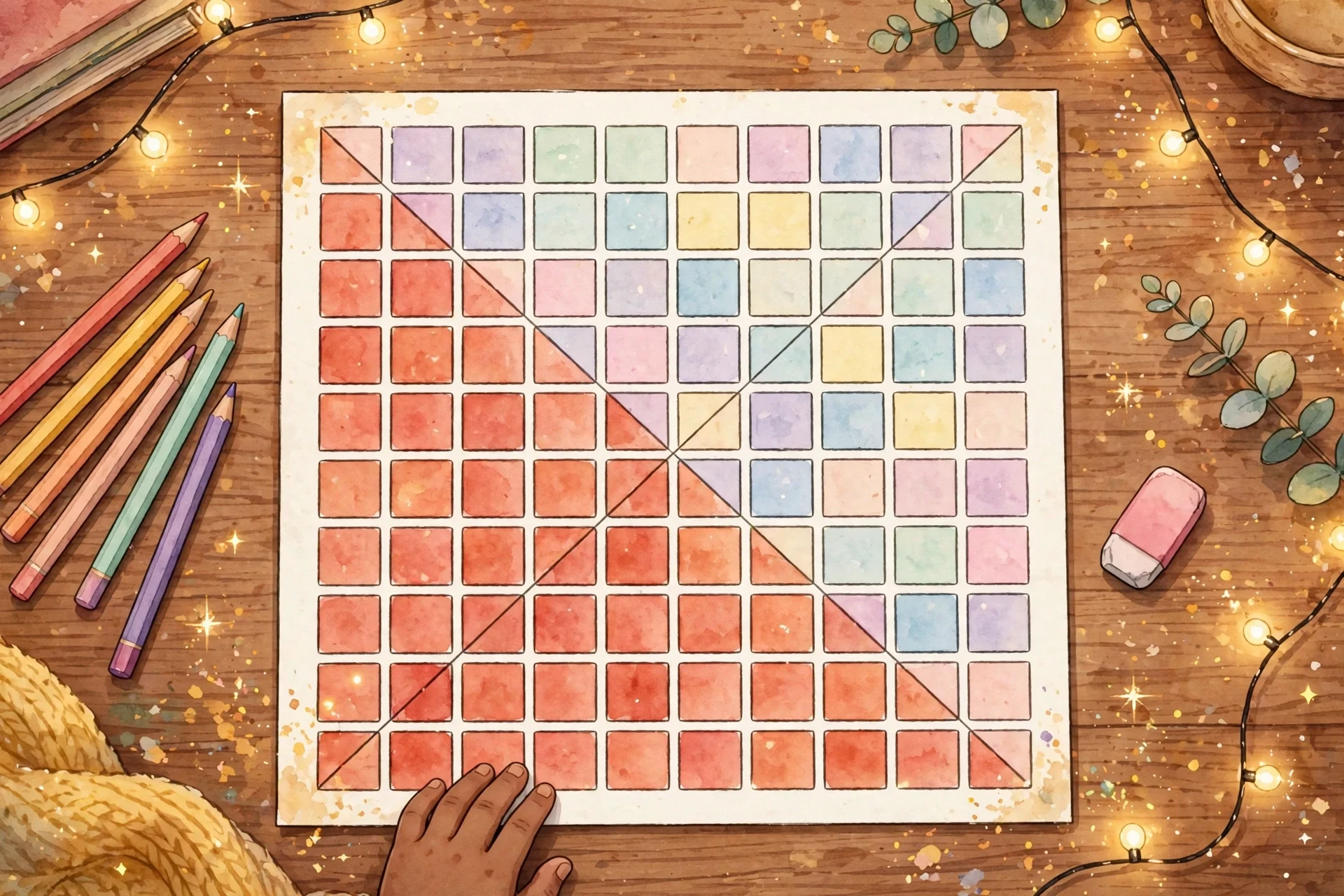
Once a child trusts that 6 times 9 and 9 times 6 are the exact same fact, every new fact learned effectively counts twice. For a kid who feels discouraged by the size of the task, this reframe alone often makes the whole project feel far more doable.
Combine this with the gap list from the self-check, and most older kids end up with a genuinely short list of facts left to actually learn, often well under twenty.
That shrinking list is worth pointing out explicitly to your child. A chart of twelve full rows looks like a mountain, but a list of fifteen or so individual facts, once duplicates are crossed off, usually looks like something that can be finished in a couple of weeks rather than a whole school year.
💡 Practical tip: Cross off the flipped duplicate every time a fact is confirmed known. Watching the real list shrink in half is motivating on its own.
3. Attack the Hard Cluster With Tricks and Short Sessions
The leftover gap is usually concentrated in the trickiest middle tables, commonly 6s, 7s, 8s, and 9s, since these lack the obvious patterns found in 2s, 5s, and 10s. A few memory tricks can speed this part up considerably.

The 9s table has a reliable digit sum trick that works specifically for 9 times 1 through 9 times 10: the digits of the answer always add up to 9. For example, 9 times 4 is 36, and 3 plus 6 is 9. It is a quick way to double check an answer, not a replacement for actually knowing the fact. Our roundup of techniques to memorize times tables fast has a few more tricks like this one for the trickiest facts.
Short, frequent sessions beat long ones here too, five to ten minutes a day on just the remaining gap facts. Games built around beating a personal best, like Rocket Dash, work well for older kids when framed as a speed challenge rather than a kids' game, since the core idea, chasing your own record, appeals at any age.
💡 Practical tip: Let an older child set their own practice goal, like "I want to beat my last Rocket Dash score," rather than assigning the practice. Ownership matters more as kids get older.
Once the actual facts are solid, speed on a school timed test tends to follow on its own. If a timed test still feels stressful even after the gaps are filled, our guide on kids who blank on timed tests covers that separate, more common issue.
4. Methods and Materials That Do Not Feel Babyish
Nothing shuts down a reluctant older kid faster than materials that look like they belong to a much younger sibling. Swapping cartoon flashcards for a plain notebook, a basic timer, or a phone stopwatch makes the same practice feel appropriately grown up.

Real-world math is another strong option at this age. Doubling a recipe, splitting a restaurant bill, or calculating change all use the exact same facts in a context that feels relevant rather than like a worksheet, which can land better with an older, more self-conscious learner.
A timer framed as a personal self-challenge, rather than a classroom test, also tends to land better here. The goal is practice that respects where the child actually is, both academically and socially, not practice that makes them feel singled out.
💡 Practical tip: Ask your child what kind of practice feels least embarrassing to them and start there. Buy-in matters more for an older kid than for a younger one.
5. What to Say, to Your Child and the School
How this gets talked about matters as much as the practice itself. Framing it as "we found a few specific facts to tighten up" protects confidence far better than "you need to relearn your times tables," which can feel like a much bigger, more discouraging task than it actually is.

It can help to mention to your child's teacher that you have identified a specific gap and are working on it at home, so classroom expectations and home practice line up without your child feeling caught between two different messages.
Most of all, keep the tone matter of fact. Plenty of capable kids hit a gap like this, and closing it is a solvable task, not a sign that something is wrong.
💡 Practical tip: Celebrate the specific facts that get locked in, not just a final finished chart. Visible, incremental progress keeps an older kid motivated through a short catch-up plan.
Common Questions About Catching Up on Times Tables
Is it normal for a 5th or 6th grader to not know their times tables yet?
Yes, it is more common than most parents think, and it is fixable. A shaky year of math, facts memorized briefly for a test and then forgotten, or a few missed units can all leave gaps that carry forward without anyone noticing until the facts are needed again.
Does an older child need to relearn all twelve times tables from scratch?
Almost never. Most older kids already know a solid portion of the facts and are only missing a specific cluster, often in the 6s, 7s, 8s, and 9s. Finding that exact gap is faster than restarting from the beginning.
How do you help an older child with times tables without it feeling babyish?
Swap anything that reads as aimed at younger kids, like cartoon flashcards, for plain notebooks, self-timed challenges, and real-world math involving money or cooking. Framing practice as closing a specific, known gap rather than starting over also helps protect confidence.
How long does it take an older child to catch up on times tables?
Many kids close a specific gap within a few weeks of short, focused daily practice, since they are usually missing a cluster of facts rather than the whole chart. Consistency matters more than session length.
Close the Gap, Not Overhaul Everything
Everything on the site is free, including speed games that work just as well for older kids chasing a personal best.
🚀 Start the Catch-Up PlanWorks on tablets, computers & phones • No sign-up needed • Everything on the site is free
A Smaller Task Than It Feels Like
A times tables gap in 5th or 6th grade feels bigger than it actually is. Once the real gap is identified, cut roughly in half by flipped facts, and tackled with short, respectful practice, most older kids close it faster than anyone expected.
Keep the tone calm, the sessions short, and the materials age appropriate, and this becomes a solvable project, not a source of embarrassment.