
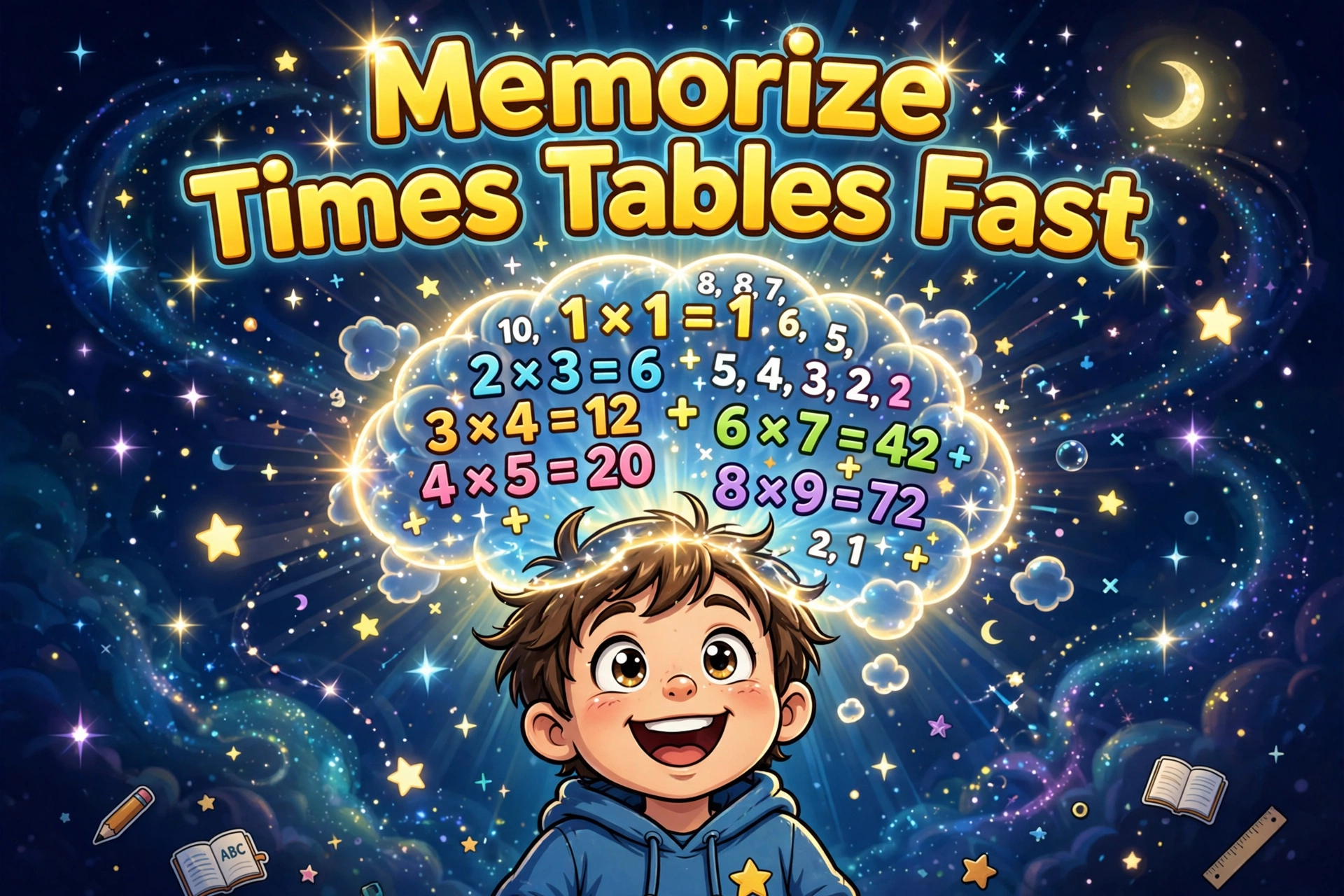
Quick answer: If you are wondering how to memorize multiplication tables fast, pair a memory technique with short, repeated practice. The 9 techniques here include story mnemonics, skip counting, clapping rhythms, songs, speed flashcard drills, spaced review, and the teach-back method, each aimed at helping a specific type of fact stick faster than plain repetition alone.
Once a child understands what multiplication means, the next challenge is speed: pulling the right answer out of memory instantly instead of recalculating it every time. That is a different skill from understanding, and it responds well to specific memory techniques.
This guide focuses purely on techniques for memorizing individual facts quickly. If you are also looking for the overall teaching order and a day-by-day plan, our guide on how to teach times tables for long-term memory covers that in depth.
None of these 9 techniques require special materials or a tutor. Most use things already in the house, a deck of cards, a pencil, or just your voice, and each one targets a slightly different way facts tend to get stuck in memory: through story, pattern, sound, repetition, or explanation.
1. Story Mnemonics for Stubborn Facts
A good story mnemonic gives an otherwise random fact, like 7 times 8, a tiny narrative hook that is much easier to recall than two bare numbers. The brain tends to remember a vivid scene far longer than an abstract pair of digits, which is exactly why a silly image sticks when flat repetition does not.

Technique 1: Silly Story Pairs
Turn a hard fact into a short, ridiculous mini-story. For 6 times 7 equals 42, try: "Six and seven went on a bus, and it had forty-two seats." The sillier the image, the more likely it sticks.
Technique 2: Rhyming Mnemonics
Rhymes work the same way as stories but lean on sound instead of imagery. "Six times six, pick up sticks, thirty-six" is a classic example your child can chant while practicing. Rhymes are especially useful for facts that otherwise have no visible pattern, since the rhyme itself becomes the pattern your child's memory latches onto.
💡 Practical tip: Let your child invent their own stories and rhymes instead of only using ones you supply. Facts they create themselves tend to stick better than ones handed to them.
2. Skip Counting Techniques
Skip counting is one of the fastest routes to real fluency on the easiest tables, since the pattern itself does most of the memorization work. Instead of memorizing twelve separate, disconnected facts, your child learns one repeating pattern and applies it over and over, which is a much lighter mental load.

Technique 3: The Skip Counting Chant
Count out loud by the target number in a steady rhythm, 5, 10, 15, 20, repeating it daily until it becomes automatic. This works especially well for the 5 times table and the 10 times table.
Technique 4: Stepping Stone Counting
Draw or lay out physical "stepping stones" numbered with the skip count sequence. Your child hops from stone to stone while saying each number, turning an auditory pattern into a physical one as well. This works especially well for kids who find it hard to sit still, since the movement itself becomes part of the memory rather than a distraction from it.
💡 Practical tip: Once skip counting is solid in order, practice it out of order too, asking for just the 4th or 7th stop in the sequence, so your child is recalling facts instead of only reciting a chant.
3. Rhythm and Music Techniques
Putting facts to rhythm gives the brain an extra hook beyond plain numbers: beat and melody. It is the same reason a jingle from a commercial can be harder to forget than something you read once in a textbook.

Technique 5: Clapping Patterns
Clap out the problem, then clap out the answer in a distinct rhythm: three claps, a pause, four claps, a pause, twelve claps. The physical beat reinforces the fact alongside the words.
Technique 6: Multiplication Songs
Set a table to the tune of a song your child already knows well, like a nursery rhyme. Familiar melodies make new information easier to hold onto because the brain already has a place to file it, instead of trying to store a brand new tune and a brand new fact at the same time. You do not need to write original lyrics either; simply chanting the full sequence of a table to a steady beat works almost as well as a proper song.
💡 Practical tip: Sing or clap in the car. Dead time during a commute is a free, low-pressure window for this kind of repetition.
If your child responds well to rhythm and play, our roundup of screen-free multiplication games has more ways to turn practice into something closer to play.
4. Flashcard Drills Done Right
Flashcards get a bad reputation as boring, but the way they are used matters more than the tool itself. Flipping through the same full deck in the same order every day is what makes flashcards feel tedious; sorting and focusing on trouble spots is what makes them effective.

Technique 7: Speed Sorting
After each round through the deck, sort cards into "instant," "hesitated," and "missed" piles. Spend the next round almost entirely on the missed pile. This focuses effort exactly where it is needed instead of re-drilling facts already known, which is often why plain flashcard practice feels slow: most of the deck does not actually need more repetition.
Technique 8: Spaced Review
Instead of drilling a new fact ten times in one sitting, review it the next day, then a few days later, then after a week. Research on spaced learning published by the National Institutes of Health has found that spreading out review sessions improves long-term recognition memory compared to repeating the same information all at once. Our practice quizzes let you revisit specific tables on your own schedule to build this kind of spacing into a normal week.
Talk with your child's teacher or doctor about what fits them.
💡 Practical tip: A simple paper calendar works fine for tracking spaced review. Mark which facts to revisit tomorrow, in three days, and in a week.
5. How to Memorize Multiplication Tables for Good
The final technique ties everything else together by testing whether a fact has truly moved into long-term memory, rather than just living in short-term recall from a recent practice session.
Technique 9: The Teach-Back Method
Ask your child to explain a fact back to you as if you were the one learning it: "Why is 6 times 7 equal to 42?" Being able to teach a fact, not just recite it, is one of the clearest signs it has truly stuck rather than being guessed correctly by chance. If your child struggles to explain a fact, that is a useful signal to revisit it with one of the earlier techniques rather than assume it is fully learned.
Every child learns differently, and some respond better to certain techniques than others. Talk with your child's teacher or doctor about what fits them, especially if progress feels slower than expected despite consistent practice.
See the best order to learn times tables →Common Questions About Memorizing Times Tables
How long does it take to memorize a full times table?
With consistent short practice using a mix of these techniques, most children can memorize one full table, such as the 6 times table, within one to two weeks.
Which techniques work best for the hardest facts, like the 7s and 8s?
Story mnemonics and rhymes tend to help most with awkward, pattern-free facts, since they give the brain something memorable to attach to an otherwise random pair of numbers.
Should I use all 9 techniques at once?
No. Introduce two or three at a time so your child is not overwhelmed, then add more as the first ones become comfortable habits.
Put These Techniques Into Practice
Everything on the site is free and pairs well with the techniques above.
Works on tablets, computers & phones • No sign-up needed • Everything on the site is free
Pick a Technique and Start Today
Memorizing times tables fast is less about finding one perfect trick and more about matching the right technique to the right fact, then backing it up with short, repeated practice. A silly story might crack 7 times 8, while a clapping rhythm locks in the 6s. Try two or three techniques this week, keep whichever ones your child responds to, and drop the rest.
For the bigger picture on which tables to teach first, see our guide to the best order to learn times tables, then come back here whenever a specific fact needs extra help sticking.